SYSTEM / 002 — CASE STUDY
UNPOL Capacity-Building & Development Integrated Planning Tool
UNOFFICIAL / ACTIVE DEVELOPMENT
UNOFFICIAL / EDUCATIONAL & DECISION-SUPPORT PROTOTYPE
A structured planning prototype for analysing policing environments, stakeholders, priorities, sequencing and implementation in peace-operation and security-sector reform contexts.
Chapter 01
Context
UNPOL advisory teams, SSR specialists, peace operations planners, Rule of Law practitioners and training users must translate mandates into context-sensitive capacity-building work.
Chapter 02
Problem
Policing reform is politically sensitive and dependent on context, actor motivations and institutional constraints. Sequencing cannot be reduced to a generic ranking or detached from local ownership.
Chapter 03
Design Principle
Structure analysis without automating strategic decisions. Preserve source links, analyst classifications and human-reviewed sequencing, with transparent limits on the prototype heuristic.
Chapter 04
System
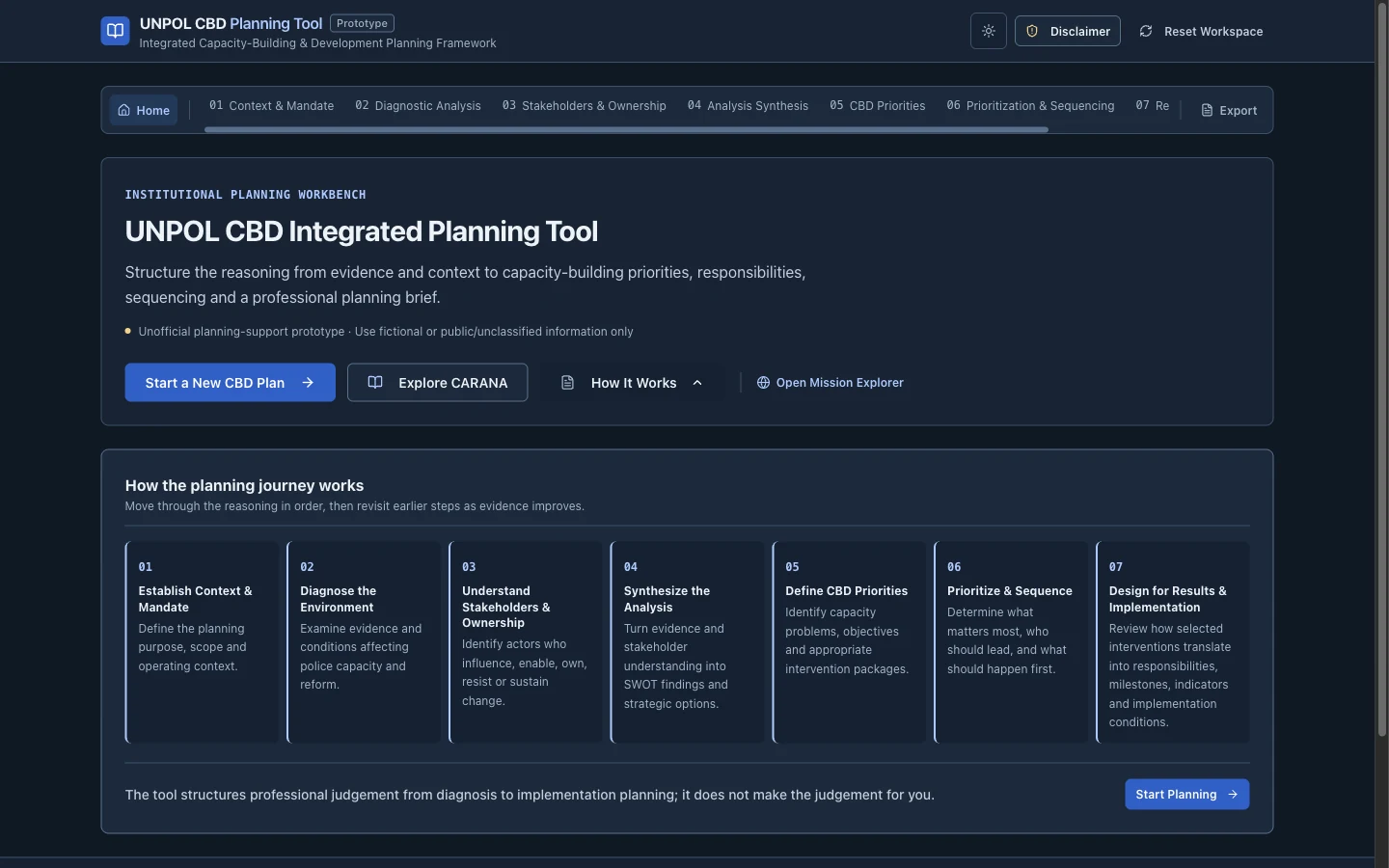
An unofficial educational and decision-support planning prototype. PESTEL-S analysis, stakeholder mapping, optional SWOT/TOWS synthesis and CBD priorities lead into prioritization and implementation planning.
Chapter 05
Workflow
- Context & Mandate
- Diagnostic Analysis
- Stakeholders & Ownership
- Analysis Synthesis
- CBD Priorities
- Prioritization & Sequencing
- Results & Implementation
Export is a separate persistent action, outside the seven numbered planning stages.
Chapter 06
Current State
- Seven-stage planning journey with a separate Home / Planning Overview.
- PESTEL-S diagnosis and stakeholder influence, reform posture and engagement assumptions.
- Optional analyst-written SWOT findings and unscored TOWS Strategic Options.
- CBD Key Areas × Cross-Cutting Analytical Lenses matrix for capacity problems and intervention packages.
- Transparent prototype prioritization heuristic with human-reviewed sequencing.
- Browser localStorage persistence, JSON backup/restore, and separate Word, print/PDF, Markdown and JSON export.
Chapter 07
Interface
Chapter 08
Boundaries
Chapter 09
Access
Implementation facts checked against the public repository README.
SOURCE / README (opens in a new tab)